
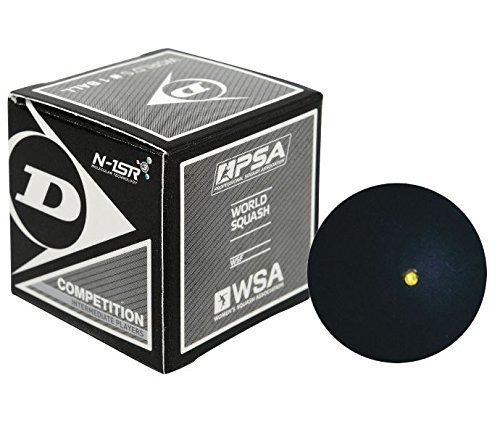
Description
The Dunlop Competition Single Yellow Dot Squash Ball sits at a sweet spot in the squash ball range — offering enough bounce for extended rallies while still demanding solid technique and court movement. Dunlop designed this ball specifically for club-level players who have outgrown red dot balls but find the double yellow dot too demanding for their current hitting power. With N-1SR³ construction technology and a 10% longer hang time than the Pro ball, it delivers reliable performance across regular practice sessions and competitive club matches.
WHAT DOES SINGLE YELLOW DOT MEAN IN SQUASH
The Squash Ball Dot System Explained
Squash balls use colored dots to indicate their speed and bounce level. Blue dot (fast, highest bounce) suits beginners, red dot (medium) works for recreational players, single yellow dot (slow) fits club and intermediate players, and double yellow dot (super slow, lowest bounce) is reserved for advanced and professional players. The single yellow dot squash ball lands in a critical middle ground — it rewards good technique while still keeping rallies alive when shots are not perfectly struck.
Until 2001, the single yellow dot was actually the standard ball used in all professional international tournaments. The double yellow dot was introduced only after the overall playing level on the PSA tour rose significantly. This means the Competition ball is far from a beginner’s choice — it is a serious performance ball that suits a wide range of skilled players.
DUNLOP COMPETITION SINGLE YELLOW DOT SQUASH BALL – KEY FEATURES
N-1SR³ Construction Technology
Dunlop uses its proprietary N-1SR³ rubber compound in this dunlop competition squash ball, delivering consistent bounce characteristics and extended durability. The compound responds predictably to temperature changes during play, so you get a uniform feel from the warm-up phase through to the final rally. The surface texture maintains good grip on court walls for accurate drives, drops, and boasts without premature wear.
10% More Hang Time Than the Pro Ball
The defining feature of this ball is the 10% longer hang time compared to the Dunlop Pro double yellow dot. In practical terms, this means the ball stays airborne slightly longer after bouncing off the front wall, giving you fractionally more time to reach the ball and set up your shot. For players developing their movement patterns and shot selection, this extra hang time makes a noticeable difference in rally length and overall enjoyment on court.
Standard 40mm Diameter
Unlike the Dunlop Progress (red dot) which is 6% larger, or the Intro (blue dot) which is 12% larger, this squash ball for club players measures a standard 40mm — identical to the Pro ball. This means players transitioning from Competition to Pro will not need to adjust to a different ball size, making the progression smooth and natural.
WHO SHOULD USE THIS SQUASH BALL
Club and Intermediate Players
If you can consistently rally 10-15 shots, drive the ball to the back wall, and execute basic drops and cross-courts, the single yellow dot squash ball is the right match for your level. It is the standard ball at squash clubs in Delhi, Mumbai, Bengaluru, Chennai, Pune, and Hyderabad for regular evening games, weekend leagues, and inter-club tournaments.
Advanced Players on Cold Courts
Many experienced players switch from double yellow dot to single yellow dot during winter months or on air-conditioned courts. Cold ambient temperatures make the double yellow dot ball sluggish and unresponsive, leading to frustratingly short rallies. The Competition ball’s extra bounce compensates for lower court temperatures, keeping the game flowing without forcing players to hit unreasonably hard just to keep the ball alive.
Coaches and Training Sessions
Squash coaches regularly stock this dunlop squash ball for structured drill sessions with advancing juniors and adult improvers. The forgiving bounce allows players to focus on technique refinement, movement drills, and shot accuracy without constantly retrieving dead balls from the front wall. It is also effective for introducing new shot patterns where continuous ball movement is needed for the drill to work.
HOW TO WARM UP YOUR SINGLE YELLOW DOT SQUASH BALL
Pre-Match Warm-Up Routine
Stand close to the front wall and hit firm, controlled drives for 2-3 minutes before starting play. The repeated impact heats the air inside the ball, raising its temperature and increasing the bounce to its optimal level. You will feel the ball becoming livelier as it warms up. On particularly cold courts, extend the warm-up to 4-5 minutes or start with short-distance volleys to generate heat faster.
Ball Care and Replacement
Store your slow bounce squash ball in a cool, dry place away from direct sunlight and extreme heat. Avoid leaving balls in car dashboards or gym bags exposed to summer temperatures. Replace the ball when the surface turns shiny and loses its matte texture — a worn ball skids unpredictably off walls and floor, reducing rally quality and increasing the risk of cracking during play. For regular club players, expect to replace after 4-6 sessions.
DUNLOP COMPETITION VS DUNLOP PRO – WHICH ONE TO CHOOSE
The Dunlop Pro (double yellow dot) has the lowest bounce in the range and is the official match ball for WSF and PSA professional events. The Dunlop Competition (single yellow dot) shares the same 40mm diameter but offers 10% more hang time. Choose the Competition if you want longer rallies at club level, need better performance on cold courts, or are working on developing your technique before stepping up to the Pro. Both balls use Dunlop’s premium rubber compound and require a warm-up before play.
FREQUENTLY ASKED QUESTIONS
Q1. What is the difference between single yellow dot and double yellow dot squash balls?
Ans. The single yellow dot squash ball has a slow bounce with 10% more hang time than the double yellow dot, which has a super slow bounce. Single yellow dot suits club and intermediate players, while double yellow dot is designed for advanced and professional-level play.
Q2. Can beginners use the Dunlop Competition single yellow dot ball?
Ans. Not recommended. Beginners should start with a blue dot (fast) or red dot (medium) ball that offers more bounce and forgiveness. The single yellow dot requires a reasonable level of hitting consistency to keep the ball warm and maintain good rallies.
Q3. Why does this ball perform better on cold courts than the Pro?
Ans. Cold temperatures reduce the internal air pressure inside squash balls, lowering their bounce. Since the dunlop competition squash ball already has 10% more bounce than the Pro, it retains enough liveliness in cold conditions to keep rallies going where a double yellow dot would feel dead and unresponsive.
Q4. How long does a Dunlop Competition squash ball last?
Ans. For regular club play, expect 4-6 sessions before the ball surface becomes shiny and the bounce grows inconsistent. Replace the ball once it starts skidding on walls or loses its matte grip — continuing to play with a worn ball affects rally quality and can lead to cracks.
Q5. Is the Dunlop Competition ball the same size as the Pro?
Ans. Yes, both measure 40mm in diameter and weigh approximately 24g. The only difference is the bounce level — the Competition has 10% more hang time. This makes transitioning from Competition to Pro seamless since the ball size remains identical.
Q6. Is this ball suitable for squash tournaments in India?
Ans. The single yellow dot is widely used in club-level and inter-club tournaments across India. For state-level and national-level competitive events, the double yellow dot (Dunlop Pro) is typically the standard match ball. However, many tournament organizers use the Competition ball for junior categories and age-group events.
Reviews
There are no reviews yet.