If you are comparing pickleball vs badminton india to decide which racket sport deserves your time, you are part of a massive shift in Indian sports culture. Two racket sports are fighting for India's courts right now — one was invented in the garrison town of Pune in the 1860s, the other in a Washington state backyard in 1965. In the last 18 months, India has added over 1,000 new pickleball courts, the World Pickleball League has brought Bollywood stars and cricket icons into franchise ownership, and paddle prices have become genuinely accessible for Indian buyers.
Meanwhile, badminton remains untouchable as India's racket sport king — with PV Sindhu, Saina Nehwal, and Lakshya Sen on the global stage, and over 20 million recreational players across every apartment society from Mumbai to Ahmedabad. The question is not which sport is better. The question is which sport fits your goals, your age, your budget, and your access to courts in 2026.
This guide compares both sports across every factor that matters for Indian players — court dimensions, equipment, rules, costs in rupees, physical demands, learning curve, and where to actually play in each major city. By the end, you will know exactly which sport to pick — or whether you should play both.
PICKLEBALL VS BADMINTON INDIA: QUICK COMPARISON TABLE
Before the deep dive, here is a scannable comparison covering the ten factors Indian players care about most:
| Feature | Pickleball 🏓 | Badminton 🏸 |
|---|---|---|
| Origin | Bainbridge Island, USA (1965) | Pune, India (1860s) |
| Court Size | 44 ft × 20 ft (880 sq ft) | 44 ft × 20 ft doubles / 17 ft singles |
| Net Height (centre) | 34 inches (86 cm) | 5 feet (1.524 m) |
| Equipment | Solid composite paddle | Strung racket |
| Ball / Shuttle | Plastic ball with holes (22–26 g) | Shuttlecock (5 g, feather or nylon) |
| Serve Style | Underhand, below waist | Underhand, below 1.15 m |
| Scoring | Games to 11, win by 2 | Games to 21, win by 2, best of 3 |
| Top Speed | Up to 95 km/h | Up to 493 km/h (shuttle smash) |
| Players in India | 60,000+ active (1M target by 2028) | 20–30 million recreational |
| Olympic Status | Not Olympic yet | Olympic since 1992 |
WHY THIS COMPARISON MATTERS NOW — INDIA'S RACKET SPORT SHIFT
India is witnessing a racket sport shift that nobody saw coming three years ago. Pickleball went from under 200 courts in early 2024 to over 1,200 courts by mid-2025, with 40–50 new courts added every month. Gujarat leads the country with 55 registered court businesses, followed by Telangana, Karnataka, Maharashtra, and Tamil Nadu. The All India Pickleball Association (AIPA) projects the active player base will cross one million by 2028.
The sport has serious commercial backing. India hosted the World Pickleball Championship in Mumbai in November 2024 at CCI Brabourne (17 countries, 650 players, India topped the medals with 28), followed by Bengaluru in November 2025. The World Pickleball League (WPBL) launched its first season at Jio World Garden in January 2025, with franchise ownership reading like an IPL guest list — Swiggy co-founders and cricketer Rishabh Pant co-own Mumbai Pickle Power, actor Samantha Ruth Prabhu owns Chennai Super Champs, and filmmaker Atlee owns Bengaluru Jawans.
Badminton, meanwhile, remains the incumbent. With champions like PV Sindhu, Saina Nehwal, and Lakshya Sen, the Premier Badminton League's peak of 155 million TV viewers, Yonex's ₹100 crore BAI sponsorship, and every Indian housing society equipped with a court — badminton is woven into daily life. The real question is not whether pickleball will replace badminton. It is whether both can coexist. Our answer, based on on-ground data: yes, and most active Indian players under 40 will end up playing both.
📈 India's Pickleball Boom — By the Numbers
Pickleball courts in India grew 6x in just 18 months — from ~200 in early 2024 to 1,200+ by mid-2025. One standard badminton court can be converted to pickleball with just a lower net and masking tape, driving rapid adoption in land-scarce Indian cities. KheloMore has committed ₹5 crore to add 100+ new courts across 50 cities by 2027.
HISTORY AND ORIGIN — A TALE OF TWO BACKYARDS
Badminton actually originated in India. British Army officers stationed in Pune in the 1860s played a game called "Poona" on the officers' mess lawns, using a shuttlecock and lightweight rackets. The game travelled to England in 1873, where it was formalised at Badminton House in Gloucestershire — giving the sport its modern name. The Badminton World Federation (BWF) was founded in 1934, and badminton became an Olympic sport at the Barcelona 1992 Games, with mixed doubles added at Atlanta 1996.
Pickleball has a more casual origin. In the summer of 1965, three dads on Bainbridge Island near Seattle — Joel Pritchard, Bill Bell, and Barney McCallum — improvised a backyard game using an old badminton court, wooden paddles, and a perforated plastic ball. The name came from Joan Pritchard, who compared the mix of borrowed rules to a "pickle boat" in crew racing (the popular myth about a dog named Pickles is charming but false — the Pritchard family dog was born in 1968, three years after the sport was named). USA Pickleball was formed in 1984, and pickleball has been the fastest-growing sport in the United States for four consecutive years.
PICKLEBALL COURT VS BADMINTON COURT — SIZE AND DIMENSIONS
Pickleball Court Dimensions
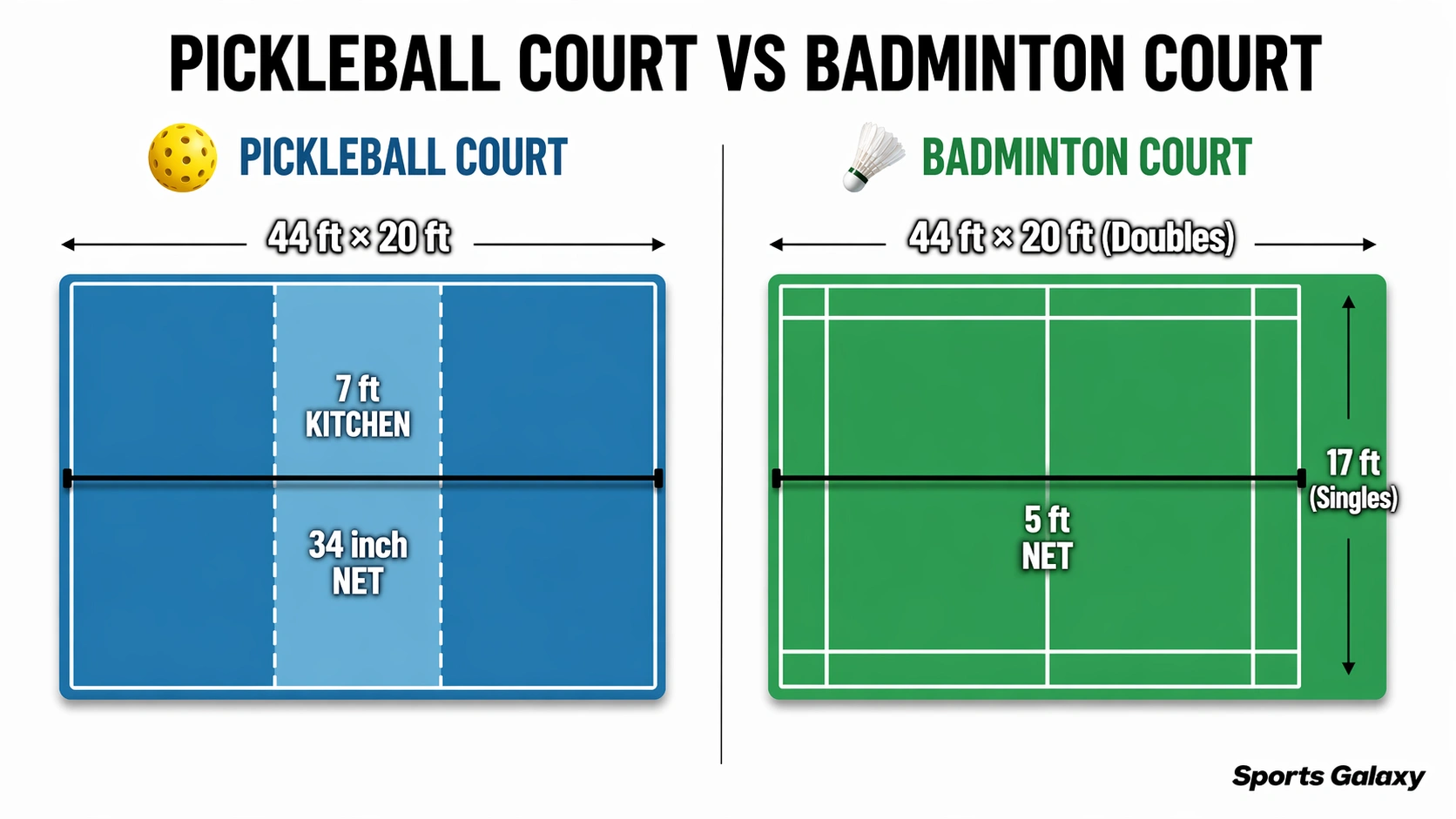
A pickleball court measures 44 feet long by 20 feet wide — exactly 880 square feet of playing area. The net sits 34 inches high at the centre and 36 inches at the sidelines. The unique feature is the Non-Volley Zone, commonly called the "kitchen" — a 7-foot area extending from the net on both sides, where volleying (hitting the ball out of the air) is not allowed. For tournament play, USA Pickleball recommends a 30 × 60 ft total area.
Badminton Court Dimensions
A full badminton court has the same 44-foot length, but the width differs by format. Doubles play uses the full 20-foot width, while singles narrows to just 17 feet. The net is significantly higher at 5 feet (1.524 m) at the centre — nearly double the pickleball net height. For international tournaments, BWF rules require a ceiling height of at least 11.88 metres to accommodate high clears and smashes.
Can You Play Pickleball on a Badminton Court in India?
Yes — and this is excellent news for Indian apartment societies, clubs, and schools. Since the doubles-court dimensions are identical (44 × 20 ft), any standard badminton court can be converted for pickleball play with zero construction. You only need a lower portable net at 34 inches and masking tape to mark the 7-foot kitchen line on both sides. Societies in Gurugram, Bengaluru, Pune, and Mumbai are doing exactly this — one court, two sports, no extra land required.
💡 Space Efficiency Truth
One tennis court can fit four pickleball courts. One badminton court can be converted to pickleball in under 30 minutes with portable net and tape. For builders, housing societies, and corporate campuses, pickleball delivers the best court-per-square-foot ratio of any racket sport — which is why adoption is exploding in metros where land is expensive.
PICKLEBALL PADDLE VS BADMINTON RACKET — EQUIPMENT COMPARED
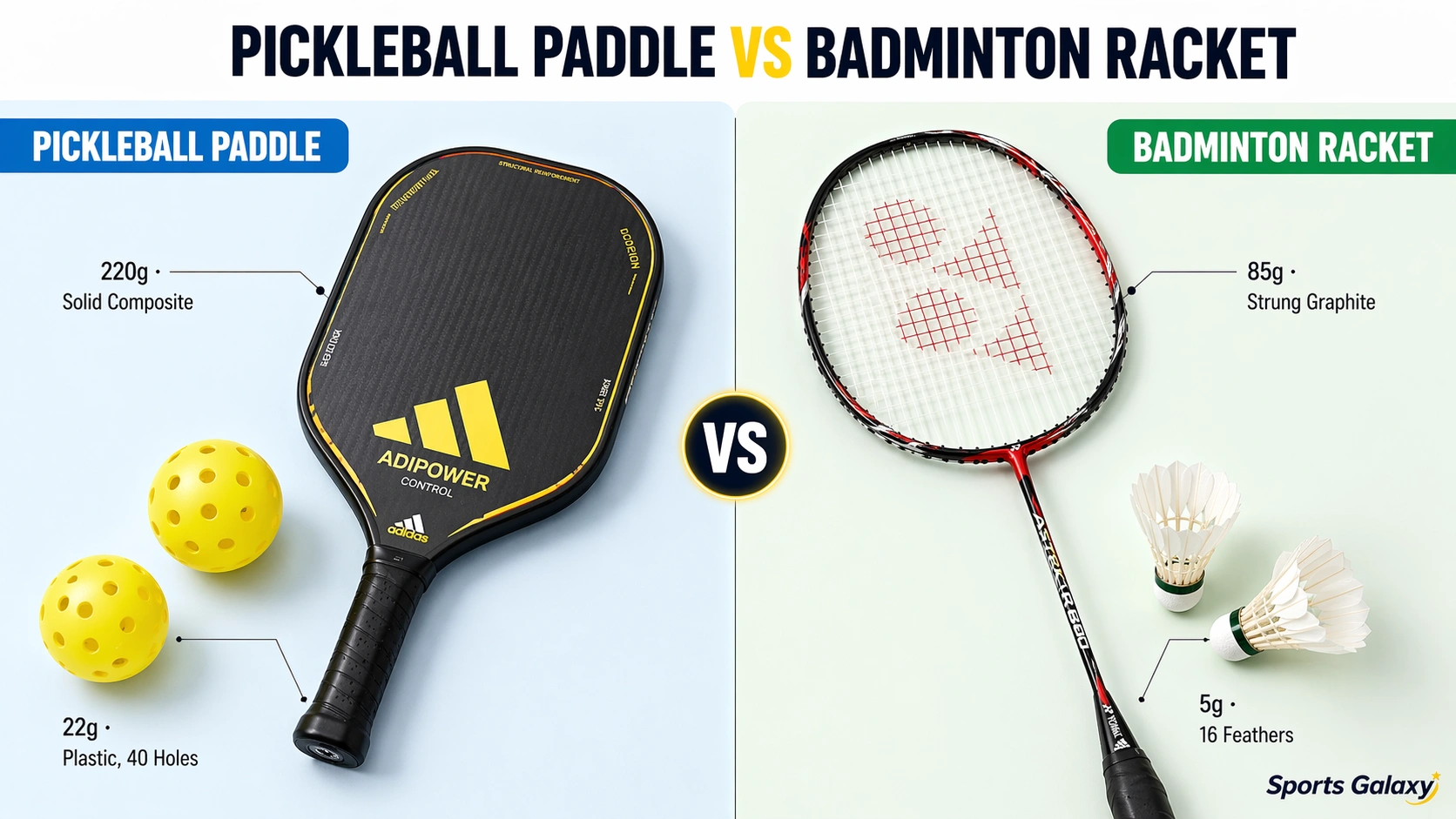
This is where the two sports feel most different in your hands. The pickleball paddle vs badminton racket comparison is not just about strings versus no strings — the weight, size, technique, and durability all diverge significantly.
Pickleball Paddle
A pickleball paddle is a solid composite implement with no strings. Paddles typically weigh 204 to 241 grams (7.2–8.5 oz), with a maximum length of 17 inches. The hitting face is built from graphite, carbon fibre, or fibreglass, while the core uses a polymer honeycomb for the power-control balance. Paddles come in two main shapes — standard for all-court play and elongated for extra reach and spin. Beginners typically start with lighter all-court paddles; advanced players move to elongated carbon models.
Badminton Racket
A badminton racket is a strung, aerodynamic frame weighing just 70 to 95 grams — remarkably lighter than a pickleball paddle. The maximum length is 680 mm, and string tension ranges between 20 and 35 pounds depending on player level. Rackets are classified by weight codes:
- 3U (85–89.9 g) — for power players who want more mass behind smashes
- 4U (80–84.9 g) — balanced all-round play, most popular in India
- 5U (75–79.9 g) — speed-focused players who prioritise fast exchanges
Modern rackets use high-modulus graphite and nanomaterial frames for stiffness and energy transfer.
Pickleball Ball vs Shuttlecock
The pickleball ball is a hollow plastic sphere with 26 to 40 holes, weighing 22 to 26.5 grams. Outdoor balls use 40 holes and harder plastic to resist wind; indoor balls use 26 larger holes and softer plastic. The shuttlecock is dramatically lighter at just 4.74 to 5.50 grams, made of 16 goose feathers fixed on a cork base for competitive play or nylon for recreation. Indian conditions favour nylon shuttles for durability — feather shuttles degrade quickly in humidity and cost ₹1,500+ per box of 12, while nylon shuttles last 10+ games at ₹700–₹1,200.
Equipment Price Reality — India 2026
Branded paddles and rackets in India cover a wide range:
- Pickleball paddles (branded): Beginner ₹5,000–₹7,000 · Intermediate ₹7,000–₹10,500 · Tournament ₹13,000–₹18,500
- Badminton rackets: Beginner aluminium ₹1,400–₹2,000 · Graphite beginner ₹2,300–₹3,500 · Intermediate ₹3,500–₹5,500 · Elite ₹10,000–₹16,000
Serious recreational players move to branded starter paddles like the Adidas Match Light (₹5,850) or Babolat XPLR (₹5,780) for pickleball. For badminton, the most-recommended beginner graphite racket is the Yonex Astrox Lite 27i (₹2,299), while the Yonex ZR 100 (Set of 2) at ₹1,399 remains the cheapest branded entry point in India. We cover exact product picks for both sports later in this guide.
RULES AND SCORING — SIMPLER VS OLDER
Pickleball Rules and Scoring
Pickleball scoring is refreshingly simple for newcomers. Games are played to 11 points, win by 2 — standard match play is best of three games. Only the serving team can score points (side-out scoring), though rally scoring was introduced as an optional format in the 2025 rulebook. Three rules define the sport:
- Two-bounce rule — the ball must bounce once on each side after the serve before volleying begins
- Kitchen rule — no volleying while standing in the 7-foot non-volley zone
- Underhand serve — paddle contact must happen below the waist (drop serve also permitted since 2021)
Most new players grasp all three rules within the first game.
Badminton Rules and Scoring
Badminton uses rally scoring — every rally produces a point regardless of who served. Games go to 21 points, winning by a 2-point margin, with a cap at 30. A match is best of three games. The serve rule changed in 2018 — the shuttle must now be struck below 1.15 metres (a fixed height rather than the older waist-relative rule). In November 2024, the BWF Council endorsed a future 3-sets-to-15 format, though global implementation has not yet begun.
The key mental shift for beginners — pickleball rewards touch, placement, and patience (especially at the kitchen line), while badminton rewards explosive power and wrist technique on overhead clears, smashes, and net kills.
PHYSICAL DEMANDS — WHICH IS A HARDER WORKOUT?
Both sports deliver genuine cardio, but the intensity profile differs significantly. The pickleball vs badminton fitness comparison comes down to intensity versus sustainability — and your choice should factor in your age, joint health, and workout goals.
Pickleball — Moderate Intensity, Longer Sessions
Pickleball burns 350 to 700 calories per hour depending on whether you are playing recreational doubles or competitive singles. MET ratings range from 4.1 for older adults to 6.5 for general competitive play. Because rallies last longer and movement is limited to a 20 × 44 ft area, pickleball sustains longer sessions with lower cumulative impact on joints. Typical heart rates during recreational play stay around 148–150 bpm. This is why pickleball has exploded among players aged 35 to 65 — it delivers workout without punishment.
Badminton — Explosive Peak Intensity
Badminton is more explosive. Recreational play burns 300 to 480 calories per hour, but elite singles badminton reaches 640 to 895 calories per hour according to peer-reviewed sports science research. Competitive MET ratings hit 7 to 8, with heart rates during elite singles matches reaching 160–180 bpm. The movement involves repeated jumping, lunging, and rapid direction changes — delivering full-body conditioning but at real impact cost to ankles, Achilles, and knees.
The Verdict
Competitive badminton is the harder cardiovascular workout, particularly singles. Recreational pickleball is more sustainable for longer weekly play with less impact on the knees, ankles, and Achilles. For fitness outcomes, consistency matters more than intensity — and pickleball's accessibility keeps Indian players showing up 3–4 times per week while badminton beginners often drop off within the first month due to physical demand.
IS PICKLEBALL EASIER THAN BADMINTON?
For most beginners, yes — pickleball is easier to start. Here is why:
- Underhand serve requires no overhead technique, unlike badminton's precise toss-and-swing mechanics
- Slower ball — the perforated plastic ball travels at roughly one-fifth the speed of a badminton shuttlecock smash, giving new players more reaction time
- Smaller effective court — the 20-ft-wide court reduces the footwork burden
- Two-bounce rule naturally extends rallies, keeping beginners engaged from the first session
- Simpler scoring — games to 11 are easier to follow than 21-point rally scoring with cap rules
Most complete beginners can sustain competitive rallies in pickleball within a single one-hour session. Badminton, by contrast, demands weeks to months of practice to develop wrist snap, overhead clears, footwork patterns, and net shots. The learning curve is steeper — but the skill ceiling is also higher. Elite badminton technique takes years to master; elite pickleball strategy takes months.
Here is an interesting crossover — if you already play badminton, you will transition to pickleball quickly. Wrist control, hand-eye coordination, and overhead instincts all transfer. The hardest adjustment is adapting to a ball that bounces (shuttles never do) and learning to restrain your natural instinct to smash from the kitchen line.
COST OF STARTING IN INDIA — THE REAL MATH IN ₹
Here is a realistic, rupee-by-rupee cost comparison for Indian players — covering initial investment, consumables, and annual totals for both sports:
| Cost Category | Pickleball 🏓 | Badminton 🏸 |
|---|---|---|
| Starter Paddle / Racket | ₹5,000 – ₹7,000 | ₹1,400 – ₹3,500 |
| Balls / Shuttlecocks (per purchase) | ₹249 – ₹700 (3-pack) | ₹700 – ₹1,200 (box of 6) |
| Non-Marking Court Shoes | ₹2,500 – ₹5,000 | ₹2,000 – ₹5,000 |
| Total Starter Kit | ₹8,000 – ₹12,000 | ₹4,200 – ₹8,500 |
| Ball Replacement (per game) | ₹0 (10–20 games per ball) | ₹100 – ₹250 (feather: 1–3 games) |
| Restringing (annual) | ₹0 (no strings) | ₹400 – ₹1,200 |
| Court Fees (per hour, metros) | ₹200 – ₹1,300 | ₹60 – ₹800 |
| Coaching (per session) | ₹500 – ₹800 | ₹500 – ₹2,000 |
| Est. Annual Cost (regular play) | ₹15,000 – ₹40,000 | ₹10,000 – ₹30,000 |
Badminton is cheaper to enter but has higher ongoing consumables — feather shuttlecocks last just 1–3 games at intermediate level. Pickleball has a higher equipment cost upfront but near-zero consumables — a single pickleball ball survives 10–20 games. Court fees currently favour badminton, but this is reversing fast as dedicated pickleball facilities open across Mumbai, Bengaluru, and Pune. Over a three-year horizon, the two sports cost roughly the same.
💡 Hidden Cost Advantage
If you play both sports, non-marking court shoes and sports bag are shared equipment — meaning the true cost of adding a second sport is just the racket/paddle plus ball/shuttle. Many Indian players now own both a pickleball paddle and a badminton racket for exactly this reason.
WHERE TO PLAY PICKLEBALL AND BADMINTON IN INDIA
Both sports have strong infrastructure in India's major cities, but the distribution differs. Here is where Indian players actually show up to play in 2026 — organised by city with top venues for each sport.
🌆 Mumbai
- Pickleball: Maks Pickleball, Willingdon Sports Club, CCI Brabourne, Jio World Garden (WPBL home)
- Badminton: 100+ society + academy courts citywide
- Highlight: 34+ dedicated pickleball courts — India's highest concentration
🌆 Bengaluru
- Pickleball: 11 Point Club (India's largest with 15 international courts), Game Theory Sarjapur, Top Spin Tennis Academy
- Badminton: Established academies + residential society courts
- Highlight: India's pickleball powerhouse driven by tech community
🌆 Delhi & NCR
- Pickleball: Spuddy Noida, Rackonnect Mehrauli, Gurugram corporate courts
- Badminton: Extensive academies across Gurugram, Faridabad, Noida
- Highlight: Fastest pickleball expansion in the NCR corporate belt
🌆 Pune
- Pickleball: Growing venue network across Koregaon Park, Baner, Hinjewadi
- Badminton: Historic heritage — the sport originated here in the 1860s
- Highlight: Early pickleball adopter with active club community
🌆 Hyderabad
- Pickleball: BOUNCE, NVK Sports
- Badminton: Gopichand Academy legacy, strong academy network
- Highlight: Strong racket sport tradition transitioning into pickleball
🌆 Chennai
- Pickleball: Sathyabama University dedicated facility
- Badminton: Established clubs and academies
- Highlight: Home of Chennai Super Champs WPBL team
🌆 Ahmedabad
- Pickleball: Club Babylon + 55 registered Gujarat venues
- Badminton: Strong society-level participation
- Highlight: Gujarat leads India in registered court businesses
🌆 Kolkata
- Pickleball: East India Pickleball, Salt Lake
- Badminton: Deep club heritage
- Highlight: Hosted India's first DUPR-certified tournament in 2024
Booking platforms like KheloMore, Hudle, and Playo make court discovery simple across India — KheloMore has committed ₹5 crore to add 100+ pickleball courts across 50 cities by 2027.
TOP PICKS FOR INDIAN PLAYERS — BOTH SPORTS
Once you have decided which direction suits you, here are the best-value paddles and rackets for Indian buyers in 2026. These are the models serious recreational players actually buy — tested for Indian conditions and backed by genuine brand engineering.
Best Pickleball Paddles for Beginners
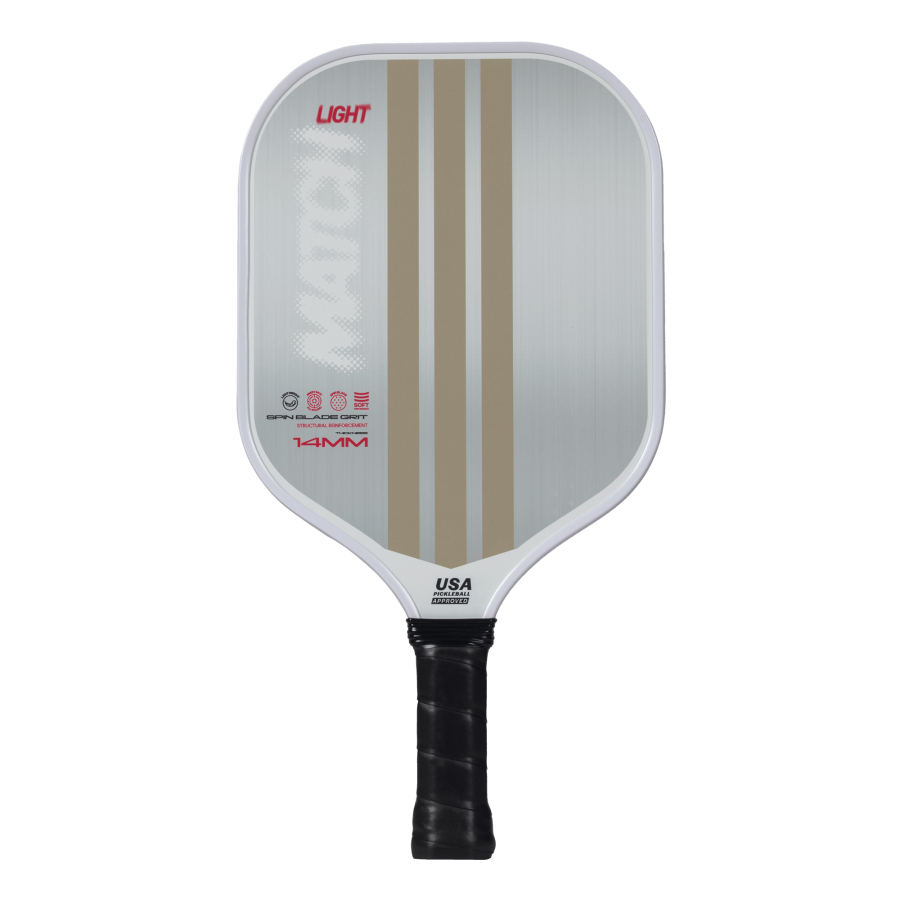
Best Beginner Pickleball Paddle
Adidas Match Light 2025 Pickleball Paddle
Adidas brand engineering at an entry-level price. Lightweight build and forgiving fiberglass face make this the smartest first paddle for Indian players starting pickleball.
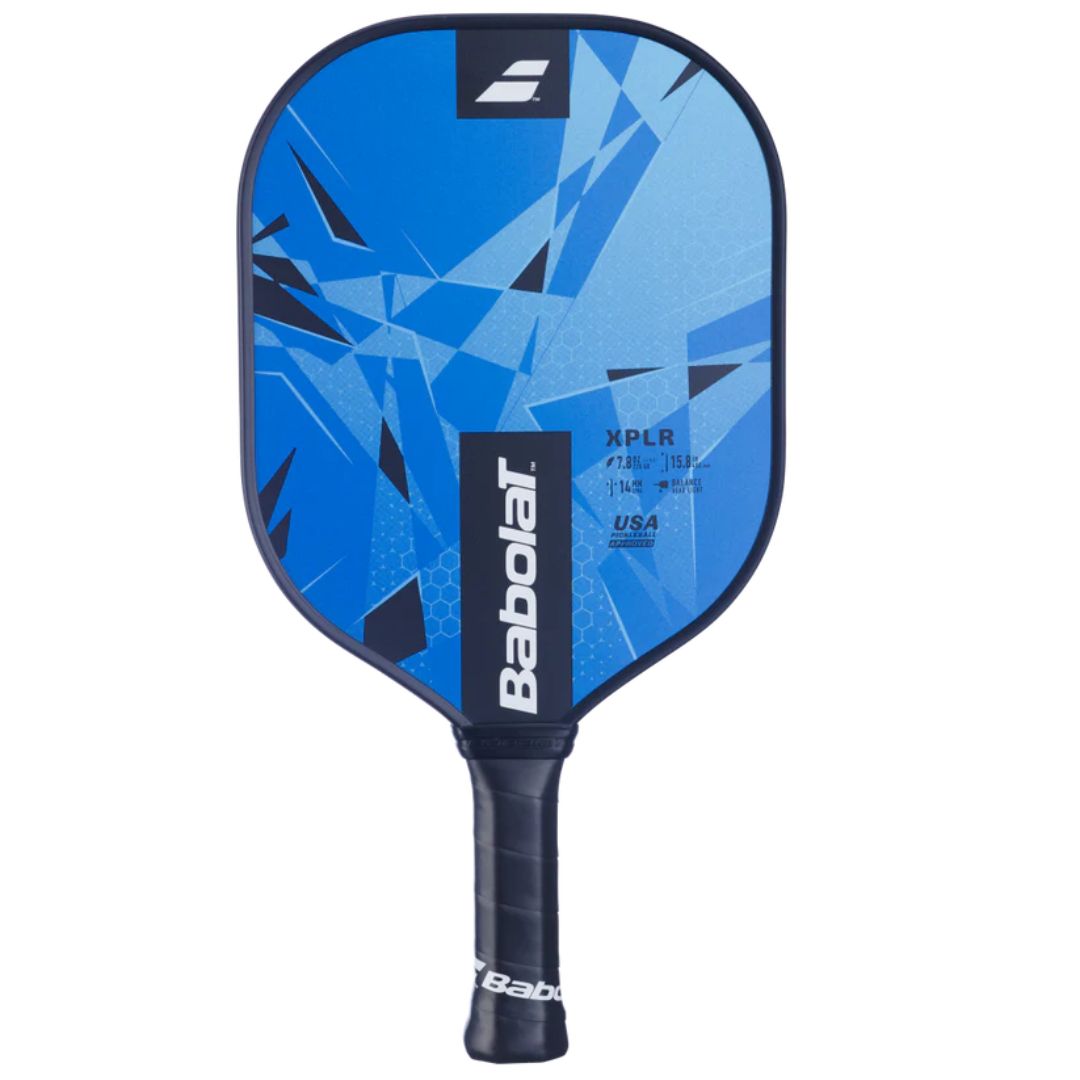
Best Value Branded Paddle
Babolat XPLR Pickleball Paddle (220g)
Babolat's most accessible pickleball paddle — lightweight, balanced, and priced below most branded alternatives. A smart choice for Indian buyers who want Babolat DNA at an entry price point.
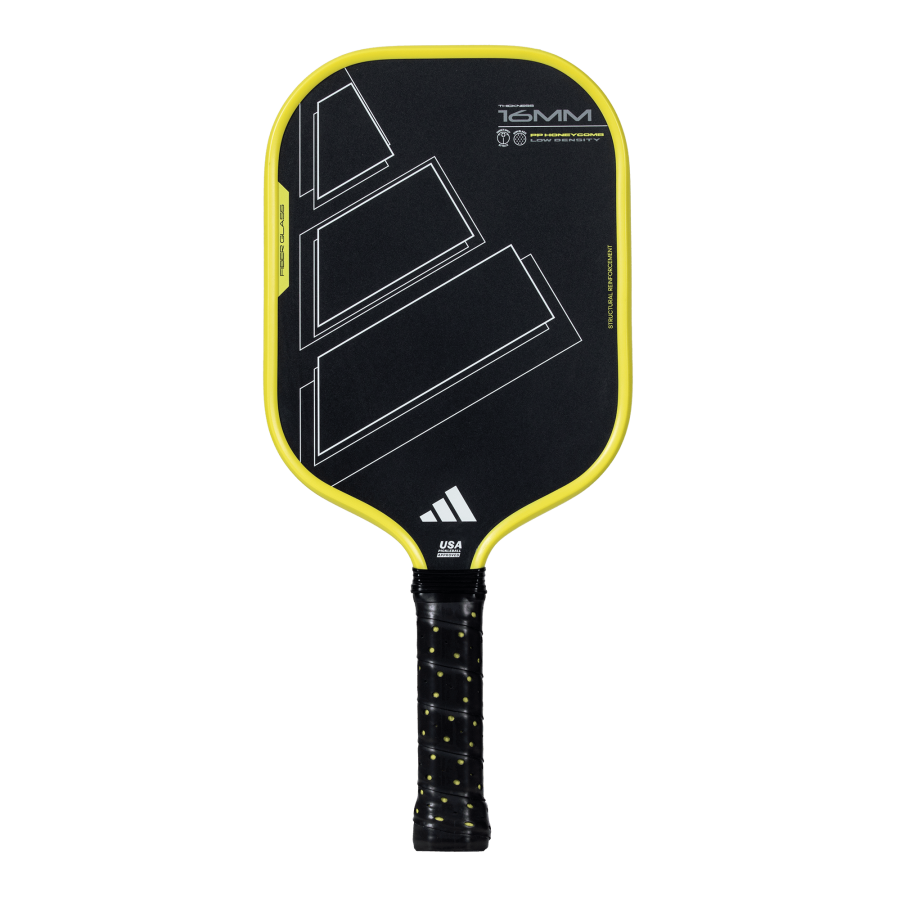
Mid-Range Intermediate Paddle
Adidas RX Team Attack 2025 Pickleball Paddle
Adidas's intermediate-tier paddle for players moving beyond beginner sessions. Carbon face adds spin and power without overwhelming technique. A natural upgrade from beginner fiberglass paddles.
Browse the complete Pickleball Paddles collection at Sports Galaxy for Adidas, Wilson, Babolat, HEAD, and Gamma options across every level.
Best Badminton Rackets for Beginners
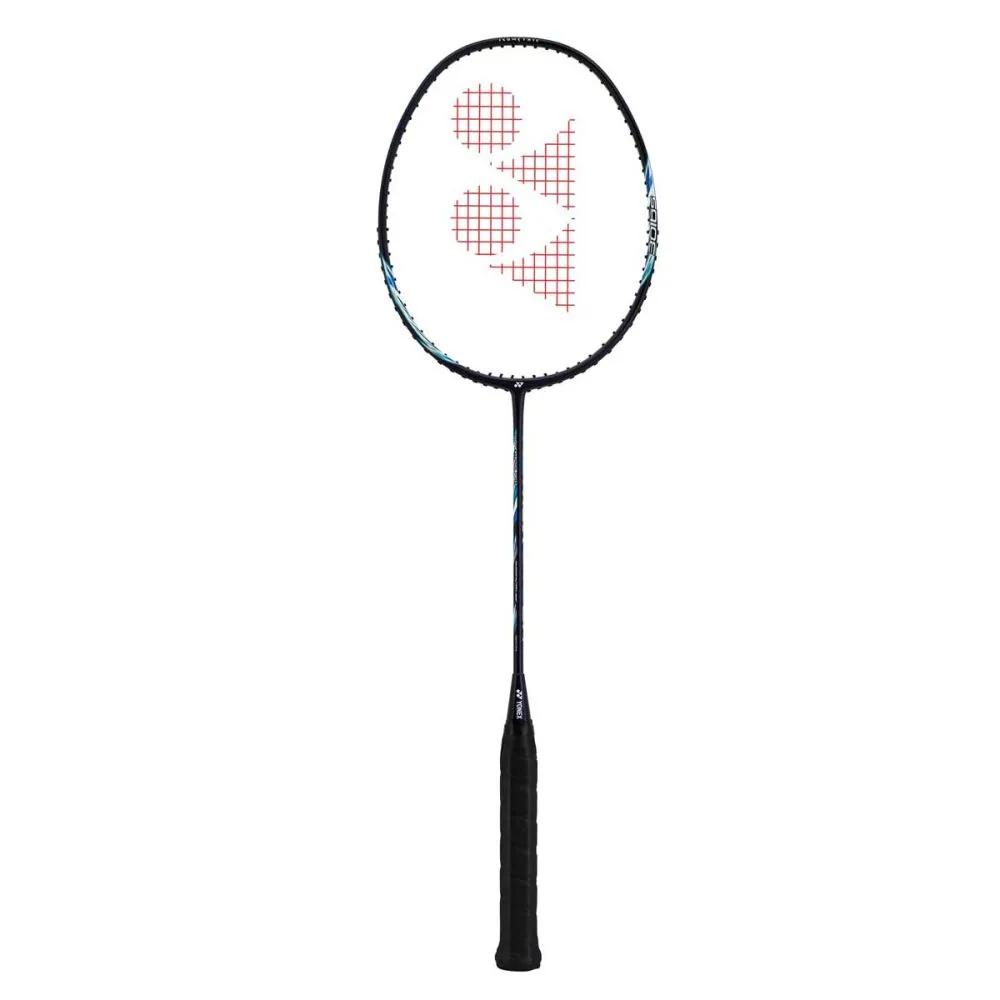
Best Beginner Badminton Racket
Yonex Astrox Lite 27i Badminton Racket
Yonex's trusted beginner graphite racket. The Astrox Lite 27i is India's most recommended first badminton racket — balanced, forgiving, and built for Indian playing conditions.
Lowest-Budget Starter
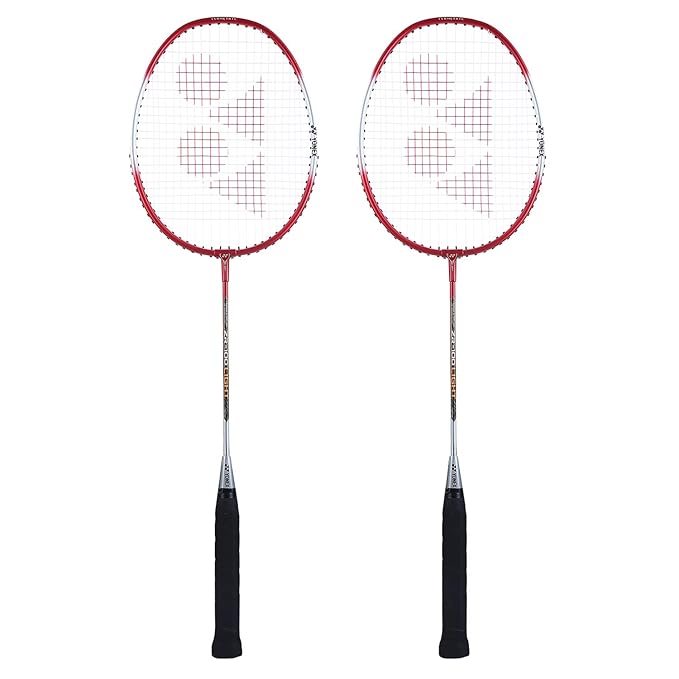
Yonex ZR 100 Light Aluminium Badminton Racket (Set of 2)
The most affordable branded badminton racket in India. Two aluminium rackets for the price of one beginner graphite — perfect for casual society play, school kids, or trying the sport before upgrading.
Speed-Focused Doubles Racket
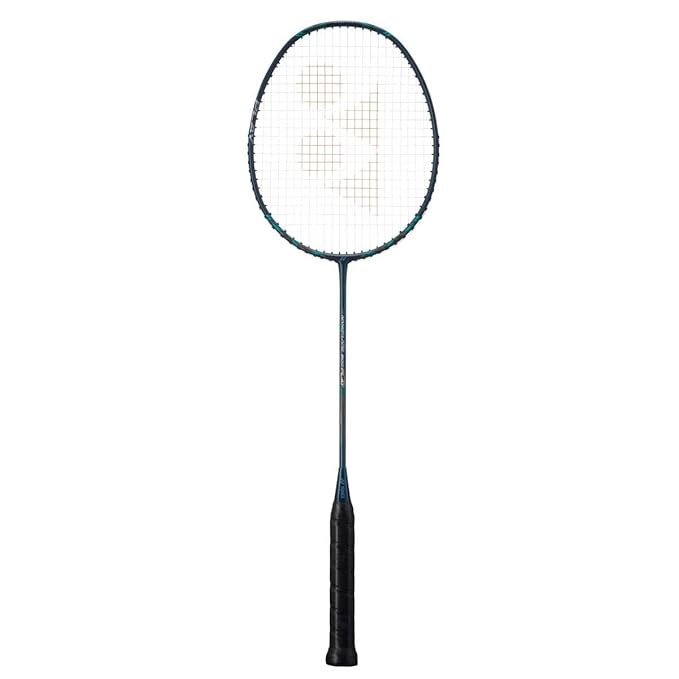
Yonex Nanoflare 800 Play Badminton Racket
Yonex's Nanoflare series is built for fast flat exchanges — the style of play dominating Indian doubles courts. Head-light balance lets you react faster at the net.
Browse the complete Badminton Rackets collection at Sports Galaxy for Yonex and Li-Ning options across every level.
PICKLEBALL VS BADMINTON INDIA — WHICH SHOULD YOU CHOOSE?
Neither sport is objectively better — they serve different needs. Here is the decision framework to settle the pickleball vs badminton india question for your specific situation:
| Choose Badminton If... | Choose Pickleball If... |
|---|---|
| You want an Olympic-pathway sport | You want to start playing from session one |
| You are under 30 and enjoy high-intensity cardio | You are 35+ and want sustainable exercise |
| You have kids aged 8–18 who want to compete | You enjoy social doubles with mixed skill levels |
| You live near a Gopichand-style academy | You live in Mumbai, Bengaluru, Delhi, or Pune with court access |
| You have a ready-built society court | Your society is converting courts for pickleball |
| You are willing to train wrist technique for months | You want instant fun with shorter learning curve |
| You prefer maximum cardiovascular intensity | You prefer moderate exercise with less joint impact |
| You follow PV Sindhu and professional badminton | You are curious about India's fastest-growing sport |
| You have strict ongoing budget | You prefer zero-maintenance equipment after purchase |
Choose both if — you are a general racket sport enthusiast. Most Indian players under 40 who try both end up playing both, because the skills reinforce each other, the brands overlap (Yonex leads badminton while Adidas, Wilson, Babolat, HEAD, and Gamma lead pickleball), and the social circles often share the same courts.
If you are still deciding, our detailed tennis vs pickleball comparison guide offers another perspective on where pickleball fits in the broader racket sport landscape.
FREQUENTLY ASKED QUESTIONS
Can I play pickleball on a badminton court in India?
Can I use a badminton racket to play pickleball?
Is pickleball easier than badminton for beginners?
Which burns more calories — pickleball or badminton?
Is pickleball popular in India in 2026?
How much does a pickleball paddle cost in India in 2026?
Will pickleball replace badminton in India?
Is pickleball an Olympic sport?
Where can I buy pickleball paddles and badminton rackets in India?
FINAL VERDICT — PICKLEBALL VS BADMINTON INDIA 2026
The pickleball vs badminton india question comes down to what you want from a racket sport. Badminton is deep, established, and Olympic-linked — it challenges your body explosively, sharpens wrist and footwork technique over years, and connects you to India's proudest racket sport legacy. Pickleball is accessible, social, and explosive in growth — it gets you playing immediately, keeps you active with moderate sustainable effort, and thrives on the community energy defining urban Indian sports culture in 2026.
For beginners, players 35+, and anyone wanting quick social play — start with pickleball. For serious athletes, competitive children, and players near academies — invest in badminton. For the smartest long-term approach — play both. The courts often share the same facility, the fitness benefits overlap, and Indian cities now offer both sports within a 15-minute drive of most metros.
Whatever you choose, invest in quality equipment from the start. A good paddle or racket does not make you a better player overnight — but it removes equipment from being a barrier to your enjoyment. That is where the real fun begins.

Pickleball or Badminton — Start Playing at Sports Galaxy 🏓🏸
Pickleball paddles from Adidas, Wilson, Babolat, HEAD, Gamma. Badminton rackets from Yonex and Li-Ning. Free shipping on prepaid orders across India.